
The 2026 FIFA World Cup, kicking off on June 11 across the United States, Canada and Mexico, will be different from any previous edition in terms of the number of teams and rules. Ahead of the tournament, FIFA and the International Football Association Board (IFAB) have introduced a series of major rule changes designed to curb time-wasting, eliminate tactical theatrics, prevent corner-kick dark arts, and protect the sporting integrity of the competition.
Here are the major changes coming into effect during the 2026 FIFA World Cup:
1. The ‘Anti-Arsenal Law’: No More Set-Piece Grappling
If there’s one team that has mastered the dark art of blocking and grappling from corners recently, it’s Arsenal.
Speaking in May Pascal Zuberbühler, head of the FIFA Technical Study Group, acknowledged the need to address the issue.
“We have seen this, especially in the Premier League with Arsenal. This has become a trend. But I believe that in our World Cup, with the best referees from around the world, they will be key to handling this type of situation.”
FIFA has now moved to prevent such scenes at the World Cup, with England’s Ben White goal against Uruguay in a March friendly cited as an example of a goal that would be disallowed under the new rule. Before the set-piece was taken, Crystal Palace midfielder Adam Wharton deliberately blocked a defender, clearing the path for White to score a tap-in.

Pierluigi Collina, now Fifa’s chief refereeing officer and chairman of the Fifa referees committee, maintained that such a goal cannot stand during the World Cup because it is completely unfair.
2. Expanded VAR Powers
When the IFAB first introduced VAR at the 2017 Confederations Cup, its scope was limited to four situations: goals, penalties, direct red cards, and mistaken identity. Nine years later, it has been extended to check these additional scenarios:
- Incorrectly awarded second yellow cards
- Incorrectly awarded corner kicks
- Fouls committed by the attacking team before the ball is in play at a corner or free-kick that directly impact a goal, penalty, or disciplinary sanction.
Now, a player can be penalised if a foul is committed before the ball is in play at a set-piece, provided the offence meets any of the following criteria: it has direct impact on a goal, or penalty kick, or worthy of disciplinary sanction, such as yellow or red card. If the referee determines that an offence occurred before the ball was in play, the appropriate disciplinary action will be taken and the corner kick or free kick will be retaken.
Also, VAR can also only intervene for incorrectly awarded second yellow-card and cannot recommend a second booking.
3. Goalkeeper Tactical “Time-Outs” Banned
You’ve probably seen this scene numerous times where a team is under immense pressure, and the goalkeeper suddenly drops to the turf with a mysterious injury. Before you know it, the outfield players are on the touchline receiving tactical instructions from their coach. Leeds United manager Daniel Farke accused Manchester City’s Gianluigi Donnarumma of this [feigning injury to break up play] when the two sides met in November.
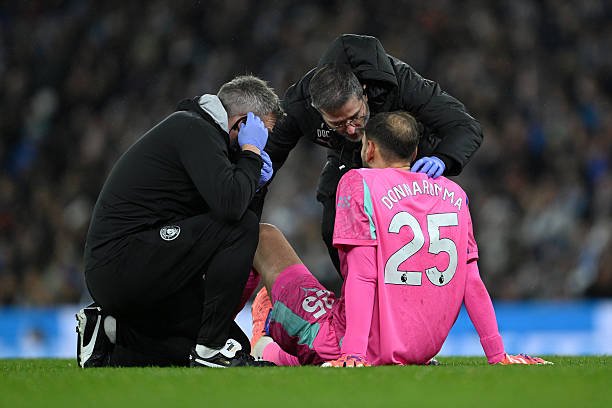
Ahead of the World Cup, Collina has moved to curb this loopholes:
“We will not allow teams going to the benches when a goalkeeper is lying on the ground injured. The goalkeeper has the right to be injured, but the players do not have the right to leave the field of play to have some sort of time out with their respective coaches.”, he said.
4. Five-Second Countdown for Throw-Ins and Goal-Kicks
To eliminate time-wasting, throw-ins and goal-kicks must now be taken within five seconds with the referees using a visual raised-hand countdown. If a throw-in is not taken before the countdown expires, possession will be awarded to the opposition. In the case of goal-kicks, the opposing side will receive a corner kick.
5. The 10-Second Substitution Rule
Players being substituted will now have just 10 seconds to leave the pitch once the substitution board is raised and must exit at the nearest sideline. If a player fails to leave within the allotted 10-Second, the replacement will only be allowed onto the pitch at the first stoppage after one minute has elapsed following the restart.
This rule was applied for the first time in a pre-tournament friendly between Japan and Iceland. Iceland’s Kristian Hlynsson took more than 10 seconds to leave the pitch. Because of this, his replacement, Isak Thorvaldsson, had to wait a full minute before he could enter. Within this period, Koki Ogawa scored the only goal of the match in the 87th minute to secure a 1-0 victory.
6. The One-Minute Injury Rule
If an outfield player requires medical staff to enter the pitch for treatment, that player must leave the field and wait one full minute after play restarts before returning. Exceptions are only made for severe medical situations, such as potential concussions or heavy collisions involving goalkeepers.
7. Red Card or Forfeiture for Misconduct.
As part of the new rules, any player who covers his mouth when confronting an opponent may, at the referee’s discretion, be sent off.
“When the conversation is confrontational, covering the mouth means that you are doing something very wrong, potentially, and the sanction is the red card.”—Collina.
The rule follows an incident in February 2026 during a Champions League match between Benfica winger Gianluca Prestianni and Real Madrid’s Vinicius Jr, with the Argentine receiving a six-game ban from UEFA for homophobic conduct.
Also, to prevent the awkward scenes at the 2025 AFCON final in Rabat, where Senegalese players abandoned the pitch in protest at a VAR-reviewed penalty awarded to Morocco, any player who leaves the field of play in protest at a referee’s decision may face an immediate red card.
The rule extends to team officials who incite players to leave the field, and any team that causes a match to be abandoned will, in principle, forfeit it
8. Formalized Hydration Breaks
To protect player safety in the North American summer heat without disrupting the flow of the game through fake injuries, matches will now feature a guaranteed three-minute hydration break around the halfway mark of each half (e.g., the 22nd and 67th minutes).
As you can see, the landscape of football is changing very fast. Yesterday’s mode of life may be replete by today. As a professional, whether player, agent or stakeholder , scaling up isn’t optinal; it’s mandatory. Visit www.ballbridge.com today and see why sports professionals around the world are already using it.
